Showing posts with label Ipoh. Show all posts

Monday, November 15, 2010

Perak's former tin mining towns linked to Sun Yat-sen - Star

By FOONG THIM LENG

Dr Sun Yat-sen’s numerous supporters in Malaya played a role in the revolution that changed the history of China.

THE many former tin mining towns in the Kinta Valley hide a wealth of stories – of unsung heroes whose sacrifices helped Dr Sun Yat-sen change the history of China.

Perak may not have been Dr Sun’s base, like Singapore and Penang, but its thousands of tin mine and rubber estate workers were instrumental in raising funds for the revolutionary’s activities.

Dr Sun, who played a key role in inspiring the 1911 Revolution which brought an end to the Qing Dynasty, the last imperial dynasty of China, is best remembered as the founding father of Republican China. But not much is known about his activities in then Malaya.

The words of Dr Sun Yat-sen are inscribed on a wall of the Sun Yat-sen Gallery in the Perak Cave Temple.

Stories from small, old towns are normally carried down the generations by word of mouth. Much information may have been lost along the way, and even the descendants of Dr Sun’s supporters have little to tell.

So it is not surprising that few have heard stories like Dr Sun’s romantic link with his bodyguard’s sister, Chen Cuifen, while in Nanyang (South-East Asia).

Chen from Fujian met Dr Sun when she was 17. Extremely dedicated to Dr Sun and his cause, Chen was his constant companion in Nanyang. She washed, cooked for many of Dr Sun’s comrades, delivered important documents, and even smuggled dangerous explosives.

Chen and Dr Sun’s first wife, Lu Muzhen, treated each other like sisters. Although not officially married, she was known as Dr Sun’s Nanyang wife to his descendants.
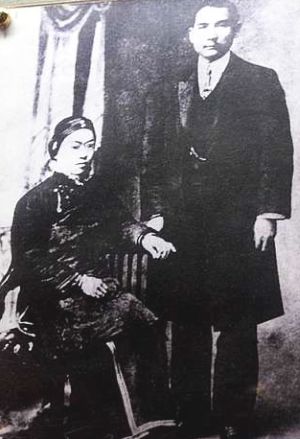
Family photos: A picture of Chen Cuifen and Dr Sun Yat-sen at the Sun Yat-sen Memorial Museum in Guangzhou.

On her death, she was allowed to be buried in the Sun’s family cemetery in Cuiheng village, Guangdong, China.

Chen adopted a daughter, Su Zhongying, from a rubber estate worker in Perak. Su later married Sun Qian, a grandson of Sun Mei who was Dr Sun’s elder brother.

Renowned historian Prof Yen Ching-hwang said in his doctoral thesis, Chinese Revolutionary Movement In Malaya 1900-1911, that Dr Sun’s first trip to Ipoh in 1906 ended abruptly when he was threatened by well-known tin miner Foo Choo Choon who was backing a different political camp in China. Dr Sun returned to Kuala Lumpur the following day.

According to the late Foong Choon Hon, a director of the Sun Yat-sen Nanyang Memorial Hall in Singapore, on one occasion, stones and cow dung were hurled at the car carrying Dr Sun in Menglembu near Ipoh.

Foong said Dr Sun had also stayed in a shop belonging to his supporter Lee Guan Swee in Old Town, Ipoh. He would only leave the shop at night using the back lane for fear of assassins.

Chen Cuifen’s adopted daughter Su Zhongying was from Perak.

Dr Sun’s bad experiences with rich merchants made him realise that his core support came from the middle and lower social groups of overseas Chinese communities. His supporters organised themselves into small groups and were active in propaganda activities in the Perak towns of Lahat, Papan and Tronoh.

One of Dr Sun’s most loyal supporters was entrepreneur Teh Lay Seng from Ipoh.

When Teh passed away in Nanjing, China, in 1940, the Chinese Republican Government posthumously decorated him with words of praise: Benevolence and Loyalty, Honour and Peace were inscribed on his tombstone at the Hokkien Cemetery in Tambun. His sundry shop Keat Seng Leong is still being run by his descendants in Jalan Bijeh Timah, Ipoh

Lee Guan Swee, also from Ipoh, was another prominent supporter. The English-educated Lee was one of Dr Sun’s most trusted aides in South-East Asia. He spared no effort in raising funds for the revolution. Other supporters from Ipoh included Ke Shuijin, Ou Shengang, Li Xiaozhang, Tang Boling, Liu Yexing, Huang Yiyi and Liang Shennan.

Dr Sun also had the backing of Lu Wenhui and Chen Zhian from Taiping, and Yang Chaodong from Kampar.

The Perak Cave Temple with a gallery on Sun Yat-sen in Ipoh.

Together they formed the Tung Meng Hui (the revolutionary Union League) in towns in the Kinta Valley, clubs and drama troupes, to spread their propaganda. One such drama troupe in Ipoh was the Perak Chisin Seah which later became the Perak Chinese Amateur Dramatic Association.

Dr Sun’s supporters addressed the general public at street corners, along roadsides and parks, and attacked the Qing government and Qing reformists, besides preaching revolutionary doctrines.

Dr Sun’s political career was marked by a series of failed uprisings. Between 1907 and 1910, several revolts at the Sino-Vietnamese border and Guangdong in China failed because of insufficient financial support and military supplies.

The now-defunct Straits Echo in Penang condemned Dr Sun and the revolutionary movement, saying that Dr Sun was all money talk and did not have anything to show for the stream of gold that flowed his way.

Dr Sun’s supporters also met with resistance from merchants who were sympathetic to calls for political change in China, but who were aligned to reformist Kang You-wei. Many of the rich were supporters of the Qing government which offered honorary titles and positions to them.

The house where Chen Cuifen and Dr Sun Yat Sen stayed when they were in Taiping which is now a coffee powder factory.

On Nov 13, 1910, Dr Sun held the important “Penang Conference” at Armenian Street in Penang. He made an emotional appeal for funds but many rich Chinese businessmen were reluctant to associate with revolutionary politics as they were under the watchful eyes of the British in the Straits Settlements. The Penang contribution only came up to $11,500 (Straits dollars).

After the conference, fundraising campaigns were carried out in Ipoh, Taiping and Kampar, and they managed to hit the targeted $50,000 – a princely sum then.

The tin mine workers in the Kinta Valley, who were driven out of their homeland in China by poverty and the corrupt Qing government, were all fired up by Dr Sun’s revolutionary call.

It was said that the workers alone contributed $10,000 following the Second Guangzhou Uprising in April, 1911.

This was no small sum as the workers earned an average $8 to $9 a month.

A certificate signed by Sun Wen, Dr Sun Yat-sen’s birth name, in 1912 presented to the Perak Chinese Amateur Dramatic Association in appreciation of raising funds during the Canton Floods and other charitable acts.

After deducting expenses for daily necessities, the worker could at the most save $4. He had to send money home to family members in China, after which he would be left with $1 to $2 a month. Going by the amount collected, the workers must have scrimped and saved every cent they could for the cause of the revolution.

A prominent revolutionary leader Hu Hanmin said: “These workers were so enthusiastic in donating funds. They often donated between $20 and $30 to the revolution. Some even wrote down their names first and tried to pay up later.”

Besides the tin mine workers, other members of the lower social group such as hawkers, rickshaw pullers and beggars also contributed to the cause of the revolution.

The success of the fundraising campaigns in Malaya served as an impetus for similar fund-raisers by the overseas Chinese in other parts of South-East Asia and America.

Some residents in the mining towns even sacrificed their lives for the sake of the revolution.

Gopeng Museum curator Phang See Kong said a Hakka tin mine worker, Wen Sheng-cai, from Kopisan near Gopeng, was so taken by a speech delivered by Dr Sun that he returned to China and tried to assassinate Qing official Admiral Li Zhun in Canton. His attempt failed and he was captured and killed.

Phang said three Gopeng residents, Eu Tong Hong, Wan Sang Choy and Kok King Mak, later took part in the Second Guangzhou Uprising and were killed. Their names are included in the list of 72 martyrs at the Huanghuagang Memorial Park in Guangzhou.

Revolutionary activities were again stirred up when news of the Wuchang Uprising reached the people.

On Oct 10, 1911, the New Army in Wuchang revolted and seized power, marking the start of the Xinhai Revolution or the Chinese Revolution, which eventually saw the end of more than 2,000 years of imperial rule in China.

Large-scale public meetings were held in Ipoh under the auspices of the Tung Meng Hui, the underground resistance movement organised by Dr Sun. As a result of the inflammatory speeches by supporter Teh Lay Seng, more than $8,000 was collected on the spot.

On Nov 3, 1911, mass meetings held to raise funds for the revolution were reported to have attracted some 4,000 to 5,000 sympathisers in Ipoh.

About 2,000 tin mine workers from Perak were said to have left for Guangzhou within a fortnight after the Oct 10 Revolution, to join in the uprising. Those that remained behind did all they could to raise funds for the cause.

Tin miner Foo Choo Choon, who by then had switched allegiance to Dr Sun, was appointed chief fund-raising officer in South-East Asia and $234,000 was remitted from Malaya and Singapore to help the revolutionaries secure Fujian Province.

Dr Sun termed the overseas Chinese as the “Mother of the Revolution” as their financial contribution was indispensable to the success of the revolution.

In later years, tycoons in Perak, including Datuk Seri Lau Pak Kuan, Leong Sin Nam and Foong Seong, who were Tung Meng Hui leaders, continued to support Dr Sun and his new Kuomintang government.

Perak once had the most number of Tung Meng Hui members in the country.

Ipoh Chinese Chin Woo Athletic Association vice-chairman Datuk Ooi Foh Sing recalls that students in Yit Ching Primary School in Pusing where he studied, used to raise the Kuomintang flag and sang patriotic songs with verses from Dr Sun’s San Ming Chu Yi (Three Principles of the People) every Monday during assembly.

“There was an arch with the image of the Kuomintang flag on one side and the British King on the other side during the Double 10 celebrations,” he says.

Today, many of the buildings in Lahat, Pusing, Gopeng, Papan, Tronoh and Kampar where Dr Sun and his supporters had visited, have been demolished.

Dr Sun and his supporters were said to have held meetings at the Oi Low Club in Gopeng, the Anglo-Chinese Club in Papan, the Wah Seong Kok literary association in Kampar, and Teh Lay Seng’s bungalow in Jalan Sungai Pari, Ipoh.

Today, only remnants of the foundation of the Oi Low Club are visible at the site, while a four-storey building stands where the Wah Seong Kok association once stood. Teh’s residence has also been demolished to make way for development.

Few residents in Lahat remember that a settlement opposite the town was once known as Kap Meng Chun (Revolution Village) because the residents were Dr Sun’s supporters.

A cinema named in memory of Dr Sun, The Sun in Ipoh which locals called Chung Shan theatre beside the Kinta River, has also been torn down.

Other buildings established in memory of Dr Sun, including SJKC Chung Shan school in Ipoh, SJKC Chung Sun in Tronoh and SJKC San Min school in Teluk Intan are still in existence.

The Kin Kwok Daily News building in Old Town, Ipoh, still stands. The now-defunct Chinese newspaper was started by a Kuomintang supporter before World War II. The original masthead of the paper was written by Yu Youren, a Kuomintang scholar.

Perak Cave Temple chairman Chong Yin Chat said Yu was a friend of his father Chong Seng Yee, who was the last batch of graduates of the prestigious Whampoa Military Academy in Guangzhou.

Yin Chat had set up a Sun Yat-sen Gallery at the temple in 1995 in honour of the Father of Modern China.

On display at the gallery are photographs of Dr Sun, a bust presented by the Sun Yat Sen memorial museum in Taiwan, calligraphy works and reproductions of letters by Dr Sun.

An oil painting of Dr Sun in official uniform, graces the hall of the Perak Chinese Amateur Dramatic Association.

A framed certificate with the autograph of Sun Wen (Dr Sun’s birth name) dated 1912, expressing appreciation to the association for its efforts in raising funds for the Canton floods and other charitable acts, hangs proudly from the wall.

In Assam Kumbang, Taiping, the Chang Chun Pu bungalow or Evergreen Mansion, where Dr Sun and Chen Cuifen once stayed, is now owned by Aun Tong Sdn Bhd, a coffee powder manufacturing factory.

As these relics from the past lay largely forgotten by the masses, the few who remember them cherish the rich legacy and their vital links with an indomitable man who eventually became known as the foremost pioneer of Nationalist China.

Several descendants of Dr Sun from all over the world are expected to be in Penang between Nov 19 and 22 to attend the 22nd joint conference of the Sun Yat-sen and Soong Ching-ling memorials in conjunction with the International Centennial Celebrations of Sun Yat-sen’s ‘Penang Conference’.

Thursday, June 24, 2010

Silver state makes bid for Unesco listing - The Star

PERAK is seeking to list Kinta Valley, Lenggong Valley, Gua Tempurung and Royal Belum as Unesco world heritage sites, said state Tourism Committee chairman Datuk Hamidah Osman.

She said the state hoped to get Kinta Valley — which includes Ipoh, Batu Gajah and Kampar — listed as a Unesco tin heritage site by 2012.

Awesome attraction: Limestone formations ar the entrance of Gua Puteri.

Hamidah said the state was also trying to nominate Lenggong Valley as a world archaeological heritage site, Gua Tempurung as limestone heritage site and Royal Belum as the rainforest, jungle and biodiversity heritage site.

She said a committee comprising representatives from the Ipoh City Council, Kinta Heritage Group, Perak Tourism Action Council and the National Heritage Department was preparing a nomination dossier on Kinta Valley to be submitted to Unesco.

Hamidah said the committee had been tasked to identify and mark sites and buildings to be included in the dossier.

“We are looking into the possibility of promoting Visit Perak Year in 2012 and everything must be in place by then,” she said in an interview.

Hamidah said the Kinta Valley had left behind significant buildings from its glorious tin mining past.

Heritage landmark: The Neo-Classic Ipoh Railway Station in Ipoh Old Town.

She said these heritage structures were treasures that should be preserved.

“Unlike modern buildings, the old ones will be gone forever if uncared for and torn down.” she added.

Hamidah said about RM450,000 had been allocated for conservation projects in Panglima Lane (Concubine Street) which was among the sites that had been identified.

“We have roped in a team specialising in conserving old buildings from Universiti Teknologi MARA to help us,” she said.

Hamidah also said the tin dredge in Batu Gajah was another heritage structure that should be protected.

“It is our last remaining tin dredge and is in very bad shape with its pontoon badly damaged,” she said, adding the dredge caretaker had estimated RM1.5mil to fix it.

Hamidah said there had been proposals to move the tin dredge away from the outskirts of Batu Gajah and closer to towns.

“The cost to dismantle and reassemble the structure is also a killing factor, at about RM30mil,” she said.

“We have spoken to the National Heritage Department to get feedback on the matter,” she added.

Kinta Heritage Group Sdn Bhd chairman Jek Yap said Ipoh’s Old Town would be the core sector in the nomination centre.

He said the group had distributed 500,000 copies of the Ipoh Heritage Trail to rekindle the people’s interest in the cultural heritage of the city.

“We have also introduced the Ipoh Heritage Trail tour which starts from the Ipoh railway station and end at Jalan Panglima (Concubine Lane),” he added.

Participants would be taken to see 24 historic buildings and places including the Straits Trading Building built in 1907, the former tin miners club Han Chin Pet Soo built in 1929, the 1920’s Dramatists’ Hostel and the Ipoh Railway Station built from 1914 to 1917.

Yap said the group was registered in April to assist the government to “save Ipoh” and promote the city, which has more than 120 years of history.

A hotspot — then and now - The Star

By IVAN LOH (ivanloh@thestar.com.my)

PANGLIMA Lane or Yi Lai Hong (Concubine Lane in Cantonese) as it is popularly known, comes across as just another narrow street in Ipoh.

Yet the row of 27 pre-war buildings along the road has never failed to attract tourists, photographers and artists from far and near.

Old-world charm: The Once notorious Panglima Lane in Ipoh is now drawing a differnt crowd- touristsm shutterbugs and even movie producers.

It has, in fact, become a famous landmark, probably more for its notorious label as a place where mistresses are allegedly kept than as a opium haunt in the early 1950s.

Ninety-year-old Wong Koh Kee, the retired boss of Koh Kee Restaurant situated along the lane, however, doubted there were businessmen and tin miners who kept their mistresses there nor were there any brothels.

Classic design: The horizontal bars doorway is among the olden architecture that attracts visitors from near and afar to visit Panglima Lane in Ipoh.

“A story that goes round is that opium smokers would always say they are going to their mistresses instead of to the opium den when asked by friends,” he noted.

Wong said despite its reputation, the area was surprisingly peaceful back then with hardly any serious crime.

“One thing for sure is that the place is quiet and peaceful. The folks at the opium dens only wanted to be left alone,” he added.

Today, many people are still interested in the buildings’ architecture along the lane, which mainly serves as a passageway for visitors who parked their cars along Jalan Bijeh Timah to go to the coffeeshops along Jalan Bandar Timah.

Car-free: Panglima Lane has become a walkway between Jalan Bijeh Timah and Jalan Bandar Timah.

“The traditional horizontal bar gates, wooden window panes and bronze door knobs are a rare find for visitors,” said former resident Loh Vooi Leong.

“Tourists could also be seen snapping away pictures of bamboo poles placed across one window ledge to another to dry their clothes,” said the 58-year-old, adding that it was completely new to them.

Loh said the place had also become a favourite spot for location shootings, including for a Hong Kong drama series starring renowned actor Alex Man Chi Leung as well as by local producers filming Chinese New Year music videos and films. Once a hive of activity in the 1950s and 1960s, Panglima Lane is a close-knit community of mostly hawkers and traders where everyone is a familiar face.

Whether it is the birth of a child, the Chinese New Year festivities or even if a resident gets a job, there is always a cause for celebration.

As Loh puts it, “everyone was practically a family member then.”

“In times of duress, we will try to help each other and keep an eye for one another,” he said.

The lane with about 27 prewar shophouses used to house about 100 families. One shophouse would have about four to five families staying under one roof.

“Only six buildings are still occupied, four with families and the other two have become workers’ quarters,” he said, adding the rest were vacant and dilapidated.

Many residents left the place after the Ipoh City Council came down hard on street hawkers in 1998.

Loh, who spent his childhood days in the area, said life was pretty simple then.

“The boys like to play near Sungai Kinta, catching fighting fish in the river and spiders by the embankment. Given some marbles or spinning tops, we would enjoy ourselves for the whole day,” he recalled.

Resident Chou Yuet Lai, 60, said her childhood always revolved around work.

“While the boys are outside running and playing, the girls are often told to remain at home to cook, sweep the floor or wash cloths,” she said.

Even during her teenage years, she would help out at her relative’s noodle stall after school.

“It’s basically the norm for my family that if you don’t work, you won’t get money to eat,” said the retired waitress.

Sunday, June 6, 2010

Firing up an interest in dragon kilns of Ipoh

Saturday June 5, 2010 By CHAN LI LEEN, Photos by LEW YONG KAN

Sixty-year-old business: One of the dragon kilns that is still in use at Sin Cheak Seng on Jalan Kuala Kangsar, Ipoh.

IPOH may hold a secret that not many know about, not even its sons and daughters who have lived here all their lives.

A rare gem in present times, there are actually a handful of operational dragon kilns lying in our own backyard.

For thousands of years, dragon kilns — brick-built kilns shaped like a dragon and fuelled with firewood to fire ceramics — were used extensively in China and later on in parts of South East Asia due to the migration of its people.

But no thanks to modern and more convenient processes that use diesel and electricity, these old-fashioned kilns have become a dying breed.

Chin Kam Peng

According to one owner Chin Kam Peng, a third generation potter operating on Jalan Kuala Kangsar, there could be perhaps 10 dragon kilns left in Ipoh.

“Our three dragon kilns each measure 24m-long by 2.4m wide and 2.1m high and are as old as I am.

“They are still in working condition despite having been built 60 years ago by my father,” said Chin, whose company Sin Cheak Seng exports flower pots and an assortment of pottery to Europe, Australia, the United States and Canada.

Firing ceramics in dragon kilns is a long and tedious process but the results are often unexpected and worth every effort.

Polished product: Flower pots being left to cool inside a kiln.

Regardless of what the pro-ducts are, it takes up to 30 hours at above 1,400 degree Celsius to fire the pieces.

“We have to continuously stoke the fire to make sure the heat remains at that temperature,” he said, adding that it takes another 10 hours or so for the pieces to cool before they can be removed from the kiln.

“There is no short cut to it. Otherwise, the pieces will crack and have to be thrown away.

“But what we get for our time and effort are beautiful pieces that are unique from each other,” he explained.

Wood ash settles on the pieces during the firing, and the complex interaction between flame, ash, and the minerals of the clay body forms a natural ash glaze.

This glaze may show great variation in colour, texture, and thickness, ranging from smooth and glossy to rough and sharp.

Stoke up the fire: Kiln worker Tang Teng Guan feeding firewood into a dragon kiln at Sin Cheak Seng pottery workshop.

Tang Teng Guan, 52, a third generation kiln worker, had picked up the trade from the time he was 11 years old.

“It requires much practice and experience because you are to judge if the temperature is right by just looking with your naked eye.

“It is physically draining and a dirty job, which no young man is interested in doing or even know about for that matter,” he said.

Ceramic artist: Tan with his replica of a dragon klin.

In an effort to create more awareness about the dragon kiln, tea merchant Legend of Tea Sdn Bhd is teaming up with local ceramic artist Tan Vooi Yam and a group of potters from Singapore to hold a pottery exhibition next month.

“The Splendour of Tea and Clay” will feature pieces made from Ipoh clay fired in dragon kilns. The pieces will be sold to the public to raise funds for charity.

Legend of Tea advertising and promotion head Ng Sook Peng said pottery was as much an art as tea drinking.

“Ipoh is famous for our limestone hills and water. We have very good clay for making teapots but all this time, we’ve been importing clay from overseas.

“This got us thinking, why not promote our clay in Ipoh and at the same time promote the dragon kiln which is dying a natural death,” said Ng.

Life-sized-sculpture: Chong creating a torso from Ipoh clay as an art piece for a wall.

Part-time potter Vernice Chong, who is amongst three potters from Singapore taking part in the exhibition, said two remaining dragon kilns in the island state were no longer in use.

“We met Tan at an exhibition a few months ago and were very excited to learn from him that Ipoh still has dragon kilns.

“We are here to try out Ipoh clay and explore the dragon kiln, which is really very rare,” said Chong.

The 49-year-old housewife said that she was particularly fond of the natural fine lines on the pieces created from the slow firing in the dragon kiln.

Skillful handwork: Lim moulding a vase that will be fired in a dragon kiln and sold at a charity exhibition in Ipoh.

“And the inside of the kiln is most beautiful and colourful due to the glaze that ends up on its walls during the firing process,” said Chong, who was recently in Ipoh with the two other participants, Andrew Chua and Lim Hua Choon.

The exhibition will be held at the Legend of Tea showroom at No 33, Jalan Foo Yet Kai, Ipoh, Perak, from July 9 to July 15. For details, call 05-2539500.

Saturday, October 10, 2009

Perak to promote temple - Star

Oct 10, 2009 By SYLVIA LOOI

THE 137-year-old Paloh Koo Miu Temple in Ipoh Old Town will be promoted as a tourist attraction.

Perak Non-Islamic Affairs Committee chairman Datuk Dr Mah Hang Soon said the temple, together with Little India and the Concubine Lane nearby, could give Ipoh’s tourism sector a boost.

Part of the intricate carvings atop the 137-yer-old temple which will be promoted as a tourist attraction.

“With proper packaging, these three places can be included in the state’s tourism map,” he said after visiting the temple recently.

Noting that the temple is older than Ipoh city itself, Dr Mah said it had valuable antiques and interesting statues which could draw in visitors.

Among them are images of fairies and deities on the walls and roofs, brass urns and a large bell.

A caretaker of the Paloh Koo Mui Temple in Jalan Bijih Timah holding a 'weapon' crafted out of wood.

Dr Mah said assistance would be provided by the state to help promote the temple.

He also announced an allocation of RM200,000 for the temple to help its committee preserve and upgrade its amenities.

The temple is known to locals as the Ipoh Chinese Tai Pak Koong Temple because of its worship of the deity.


View Larger Map

In the olden days, it used to offer free medicine and consultation to local folk.

People with disputes even visited the temple to seek justice during its early years.

Among the temple’s milestones was when it established a free school for pupils considered too old to be admitted into government primary schools.

For those interested to visit the temple, it is located at 91, Jalan Bijih Timah.

Sunday, September 27, 2009

More pictures on Toong Wah Tong Cave Temple in Ipoh @ Jalan Tambun

Here are some more pictures taken within the vicinity of the cave temple located 50m away from Lost World of Tambun:

Main entrance of the temple

Some of the committee members of the temple

Watch the video here:


The main altar of the temple

The entrance of the temple at the foot of the hill

Look at the beautiful scenery of the temple

One of the signages at the entrance that reads: "If you arrive at the top of hill at the temple, it is fate. If you descend from the hill it is your destiny".

One of the many structures formed by stalactite and stalagmite that resembles an elephant

A view in the temple looking out from the cave

The painting of a green dragon located on the right side of the temple

Another painting of a white tigeron the left side of the temple

Another hand painting at the side of the temple

Saturday, September 26, 2009

Ipoh Famous Dim Sum - Foh San Restaurant

Sept 25, 2009

Just 2 days ago, my family and I took our chance to go to Foh San new outlet which opened about a month ago. We have tried many times before but ended up eating at Ming Court just located opposite of Foh San as we struggled to get a seat.

My sister Merlin and hubby Seng Kee enjoying their dim sum all the way from Melaka

Ooh .. that's my son Jansen and my mother-in-law

But we were lucky this time though as most of the visitors have left Ipoh after a long Hari Raya weekend. We were lucky this time as we also got a good car park and a good table labeled as C9.

See the auspicious table number with my daughter Sharon. Behind is the fully computerized payment counter

Our first impression is that it looks much better than a fast food outlet and even better than a kopi tiam. Everything was well planned and well positined with good fengshui.

We ordered quite a variety from big pau to lopak ko and of course all the other creative dim sum. Forget about the price if you realy enjoy a good dim sum as you are paying for the good ambience as well.

My sister really loves the dim sum and decided to do a ta pau. Look at the impressive take away counter

As if not enough, we managed to ta pau some of our favorite dim sum. There is a corner for take away food just by the road side strategically located.

A must for travelers to Ipoh. Foh San is located along Jalan Leong Sin Nam just behind Maybank. See map below:


View Larger Map

Wednesday, September 23, 2009

Toong Wah Tong Cave Temple

Sept 23, 2009

The 130 over years old cave temple Toong Wah Tong is located about 500m away from Lost World of Tambun on the way to Tanjong Rambutan. Visitors to this temple which is located about 60 steps high or 100 feet above ground will be fascinated with the beautiful cave.

Once you are at the temple, you can get a good view of the surrounding greenery including the lime stone hills. Founded by a famous tin miner Leong Sin Nam, the temple opens daily to the public from 9am to 5.30pm. Many tourists from around the world have come to visit this temple. Some came to offer prayers and some came to take a good view from the temple.


Local people will normally come to pray and at the same time climb the hill to keep themselves healthy. Visitors will be welcome by the writings on the wall that read: "If you can climb up the hill, it is fated and when you descend, its your good fortune".

Location Map:

View Larger Map

Monday, September 21, 2009

Great place for animal lovers - Star

Sept 20, 2009 By GRACE CHEN
sundaymetro@thestar.com.my
Photos by SAIFUL BAHRI

Be prepared for some scandalous animal stories when you visit the petting zoo at the Lost World of Tambun in Perak.


AT the last count, the animal population at the petting zoo of the Lost World of Tambun numbered 4,000, and all are descendants of those at its sister park at Sunway in Petaling Jaya. The only “newbies” are 40 tortoises whose pond is just next to a 10m-high waterfall fed by fresh river water running from the limestone hills of Kinta Valley.


View Larger Map

According to Calvin Ho, the general manager, these tortoises were rescued from a temple in Penang after it was found that they were living in terrible conditions. To compound the problem, the temple authorities found out that poachers were stealing the land reptiles and selling them to restaurants.

Handle with care: Petting Zoo keeper Nur Azlan Mohd Hussin, 23, ensures that these colourful birds are carefully handled by visitors.

Concerned that these revered crepusculars were coming to such a bad end, the temple authorities called Ho for help.

There are plenty of such anecdotes at the 7,432 sq metre “wildlife resort”.

The visitor will get to meet a cobra which had to be spoon-fed after it hurt its throat, no thanks to rough handling from villagers who had found it lurking in a chicken coop.

There is also a marmoset named Ron who has since become Ho’s best friend and confidante.

“There are no dark secrets but he knows quite a lot about what’s going on in my head,” quips the 44-year-old father of two who often starts his day by sitting among these cute furry mammals.

Then there are the raccoons who reside near the zoo’s entrance. If the animals had a gossip tabloid, the best fodder for it would come from a certain male raccoon here that has acquired quite a reputation for being a highly amorous “playboy”.

“The fellow mates no less than a couple of times within an hour,” affirms Ho.

What makes for the contentment and wellbeing of the animals in the Lost World of Tambun is the care they are being given.

Close interaction: Visitors can have direct contact with the animals.

According to Ho, the two crucial aspects lie in the conditioning and enrichment programmes devised by the curator and the keepers.

“The animals in our care are not just fed and expected to eat and sleep. To keep them active and stimulated, the keepers place their food between rocks or on branches. The animals will have to locate the grub with their senses,” says Ho.

The petting zoo, insists this Penang native, is about simulating the natural habitats of the animals to encourage them to hunt and forage for food. This keeps them alert and ensures their good psychological and emotional well being.

“The idea is to allow them to live in a habitat that resembles conditions in the wild,” says Ho.

In simulating the natural habitats of the animals, Ho reveals that first of all, no trees were chopped down during the building of the petting zoo which took four months to complete.

No effort was spared to preserve the original flora and fauna of the area that’s set within the majestic limestone hills of Ipoh. Even the water for the streams and waterfall is channelled from a river, which means chlorine-free drinking water for the animals. Extra vegetation such as creepers and trees were planted to treat soil erosion.

Ho attributes the tame disposition of the animals to the constant positive conditioning from the keepers. He eschews the word “train” as he feels that it carries negative connotations like the use of cruel methods.

“When it comes to animals, the interaction has to be like a relationship, like making friends. Just like people, animals, even among the same species, have different personalities. Some are feisty, others adapt more easily.

“When it comes to conditioning a bird to feed from a visitor’s hand, for example, this is the result of the interaction that has taken place between the animal and the keeper. It shows the deep relationship and understanding that has deve­loped between the two,” says Ho.

Exposing the animals to people, even those which have been previously mistreated by humans, will have drawbacks, but Ho feels such situations can be controlled.

“There are some people who derive plea­sure from seeing animals suffer. It is disgusting to watch and I feel that awareness should be raised through education. However, when we took on the running of the petting zoo, we also made sure that the animals’ keepers are there to supervise the interaction between visitor and the animal,” Ho says.

So, besides caring for the animals, the keepers also need to have a basic understanding of human behaviour.

“Sometimes, visitors are goaded by their friends or are pressured to drape a snake around their neck when they are just not ready for that sort of action. In this case, the keepers will size up the visitor to see how they can best experience the human-animal interaction minus the impositions,” says Ho.

So, what can the visitor expect to experience at this petting zoo, aside from getting to stroke the animals? Well, there is the serpentarium, a glass tunnel which allows the visitor a 360° view of the snakes and reptiles in the zoo’s collection. This will be as close as one can get to the pythons and monitor lizards clinging to the glass on top, below, by the sides and at one’s feet.

Then there is the boardwalk which winds across the Rock Canopy like a rainforest trail. This set-up brings a visitor to a natural paradise where hornbills, macaques, porcupines, prairie dogs and African goats are left to roam free. At the end of this trail is a platform which offers a breathtaking scenery of the wetlands area where Rajah Brooke butterflies can be seen fluttering among wild boars, squirrels, kingfishers and pangolins.

High on the adorable meter is the warrens where cute bunnies with their floppy ears can be seen hopping around.

Children can also do “longkang fishing”, a term coined by Ho, here.

“There are baby carp swimming in a small stream and children can scoop the little fish into their nets,” says Ho.

However, Ho reiterates that there is a clear line drawn on using animals for entertainment.

“The petting zoo is geared towards education, where children can learn about animals and the role they play in the ecosystem. This is crucial because if one link is broken, there will be an imbalance and this will have a negative effect on us in the end,” he says.

While one may argue that books, audio and visual means are able to perform the task adequately, Ho firmly believes that there is no greater teacher than real-life experience. As to whether the animals are happy, Ho gamely points out that their ability to mate and breed is a sure sign that all is well.

This can be seen in the aviary where eggs and new hatchlings can be found in the nests.

The Lost World of Tambun is open from 11am to 6pm on weekdays and 10am to 6pm on weekends. It is closed on Tuesdays. For enquiries call 05- 5428888 or visit its website at www.sunway.com.my.

Wednesday, June 24, 2009

Some of the best chinese food in Ipoh

June 24, 2009

Discovering some of Ipoh's great food is part of my hobby. Of course Ipoh is well known for its delicious cuisine. People from as far as Hong Kong, Singapore, KL and Penang will make a trip to Ipoh over the weekend just to enjoy to good and cheap food in Ipoh. And here in the Star Paper,I have found some of the better ones:

Yum Yum Restaurant:
Add: 5, Persiaran Greenhill, 30300 Ipoh, Perak
Tel: 05-2537686


Yum Yum Restaurant started operations in 1991. The restaurant is best known for its Nyonya Cuisine although it also serves Chinese, Thai and Vietnamese cuisines. The most popular dish which one must try is the Mango Kerabu. The Siamese Laksa is a favourite amon patrons.


Sun Lee How Fook:
Add: 96, Jalan Raja Permaisuri Bainun (Jalan Kampar), 30250 Ipoh, Perak
Tel: 05-2533268


Sun Lee How Fook is a popular venue for those who want to hold wedding or multi-course dinners. This restaurant actually started in Kuala Lumpur before the owner decides to open other branches in other cities, which includes Ipoh as well. Prices are reasonable and they serve typical Cantonese dishes.


Restoran Foh San:
Add: 2, Jalan Dato Tahwil Azhar (Jalan Osbourne), 30300 Ipoh, Perak
Tel: 05-2540308 (Moving soon to Jln Leong Sin Nam - Grand Opening on July 2)


Restoran Foh San is famous for its dim sum delicacies. For those visiting Ipoh, having a hearty dim sum breakfast at this restaurant is a must. You'll be spoilt for choice as there are over 20 types of pau, fritters, and yong tau foo for you to choose from at this place.


Ming Court Hong Kong Tim Sum:
Add: 32, 34 & 36, Jalan Leong Sin Nam, 30300 Ipoh, Perak
Tel: 05-2557134


This is another dim sum spot that is popular among the locals - especially with the senior citizens. The restaurant is usually full in the morning as even office workers will stop by to have their meal before going off to work. Ming Court is said to be the direct competitor to Restoran Foh San.


Aun Kheng Lim:
Add: 24, Jalan Theatre, 30300 Ipoh, Perak
Tel: 05-2542998


If you like Chinese salt-baked chicken, then you need to give this place a try. The owner Lim Ming Teck came upon the idea of selling salted chicken after having one for his meal during his honeymoon trip to Hong Kong. The chicken that is prepared is tender and separates easily from the bones. However, this is only a take-away shop and there is no dine-in.


Kim Bali Restaurant:
Add: A11, Jalan Dato Tahwil Azhar, 30300 Ipoh, Perak
Tel: 05-2556861


Kim Bali Restaurant was formerly known as A-ssam House. This restaurant typically serves spicy Asian food which includes Malaysian cuisine, Nyonya cuisine, Indonesian dishes and Chinese non-spicy fusion food, among others. Even international film star Chow Yun Fatt has dropped by to savour their dishes when he was in town previously.